Posts

Santorini, Greece

Image
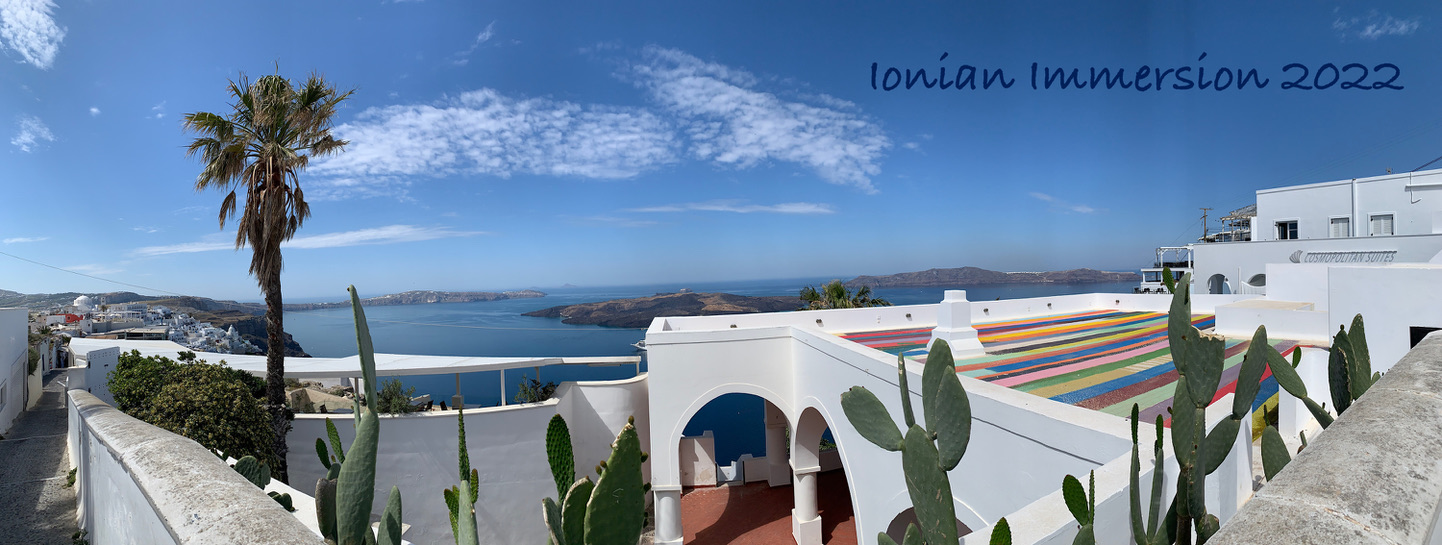
  Santorini, the scene of one of the world's most violent volcanic eruptions almost 4,000 years ago, is likely the most dramatic of all Greek islands. The white-washed town sits atop the steep cliffs of the extinct volcano's rim surrounded by a deep blue sea in every direction. The only ways to reach the town from the shoreline are a donkey trail (inadvisable) and a modern funicular. At one time riding a donkey to the summit was the only mode. Today, the donkey trail (which is otherwise walkable) has become more of a joke than a popular way to the top.  The Thera side of Santorini Funicular Thera town square Painted rooftop A Seabourn cruise ship in the distance Somebody's lovely terrace Hotel Atlantis  

Argostoli, Greece

Image
  A seaside town on the island of Kefalonia (also know as Cephalonia), Argostoli  remains a work-in-progress since its near total destruction in a 1953 earthquake. It is  still trying its best at becoming a resort destination, but it has a very long way to go to compete with the likes of Mykonos and Santorini. The island has had a tumultuous history: ruled by Norman kings from Sicily, Italian overlords, Turks, Venetians, and even the British for a short time. The town does have an attractive promenade; but the overall appearance of the port might conjure up memories of some backwater Caribbean spots in the minds of some travelers. Cathedral bell tower Public art on the promenade What the world needs more of! Along the promenade

Taormina, Sicily

Image
 Both of us had visited Taormina separately in the 1980s, arriving there from mainland Italy by ferry (Adriana) and by hydrofoil (Jim). Then it was very much a sleepy town. Today it is o ne of the most popular destinations on the island of Sicily. Taormina is well-above sea level but still below the looming active volcano, Mt. Etna. The town has a medieval atmosphere despite its Greek (and later Roman) origins. A Greek amphitheater on the edge of the town dates to the 3rd century BC and is used today for concerts because of its excellent acoustics.  A Windstar tall ship is our neighbor Lunch under Mt. Etna Town square Sail away, full moon over Calabria

Salerno, Italy

Image
Often  overlooked as a cruise ship destination, S alerno  appears to have  aspirations to be a player in the cruise industry. It has a large and very modern welcome center at the cruise dock.   Salerno is a prosperous port with one of the largest marinas in the Mediterranean. With a long history and probably of Etruscan origin, it became a Roman colony in 197 BC. Lungomare, its seaside promenade, is one of the longest in Italy. A well-groomed park is paired with the promenade. A large newly-built residential complex is adjacent to the cruise ship dock; however, it did not appear to be largely occupied at present. We surmised that the pandemic may have something to do with its vacant look.  Panorama of Salerno Lungomare Tiled dome of Santa Trofimena nell'Annunziata

Farewell to the Oceania Riviera

Image
The last night aboard ship, we passed the isle of Capri right at sunset. A fitting end to a wonderful cruise. We had stood in the palace of Diocletian, walked the fortress of old town Dubrovnik, scaled the Acropolis, and viewed the windmills of Mykonos, the heights of Santorini, Argostoli's sleepiness, Mt. Etna's fire and ice, and Salerno's promenade. Capri at sunset We were surprised and pleased to find an old friend on the cruise. We had first met Maitre d' Romanio, a Portuguese Goan, on Crystal cruises 6 years ago. We couldn't believe our good fortune to meet again after so long. Given the turnover and mobility of cruise industry staff, it was quite amazing. He's a special person and great asset to Oceania. Our friend Romanio Our two week stay in Rome was at a residence hotel on Via Vittoria, just two short blocks from the Spanish Steps. Every morning it was a delight to open the shutters and see the sun splashing on a lovely terrace across from us. Neighbori...